Why It Matters
Water left in the line freezes — and ice does not compress.
Water expands roughly nine percent when it turns to ice. Inside a sealed irrigation line there is nowhere for that expansion to go, so it goes into the pipe wall, the fittings and the brass. That is what splits an irrigation system over the winter, and none of it shows up until you turn the water back on in April.
The backflow assembly
The most expensive single component above ground, and the first thing to crack. It sits exposed, holds water, and a replacement plus the required re-certification costs far more than a blow-out.
Valves and manifolds
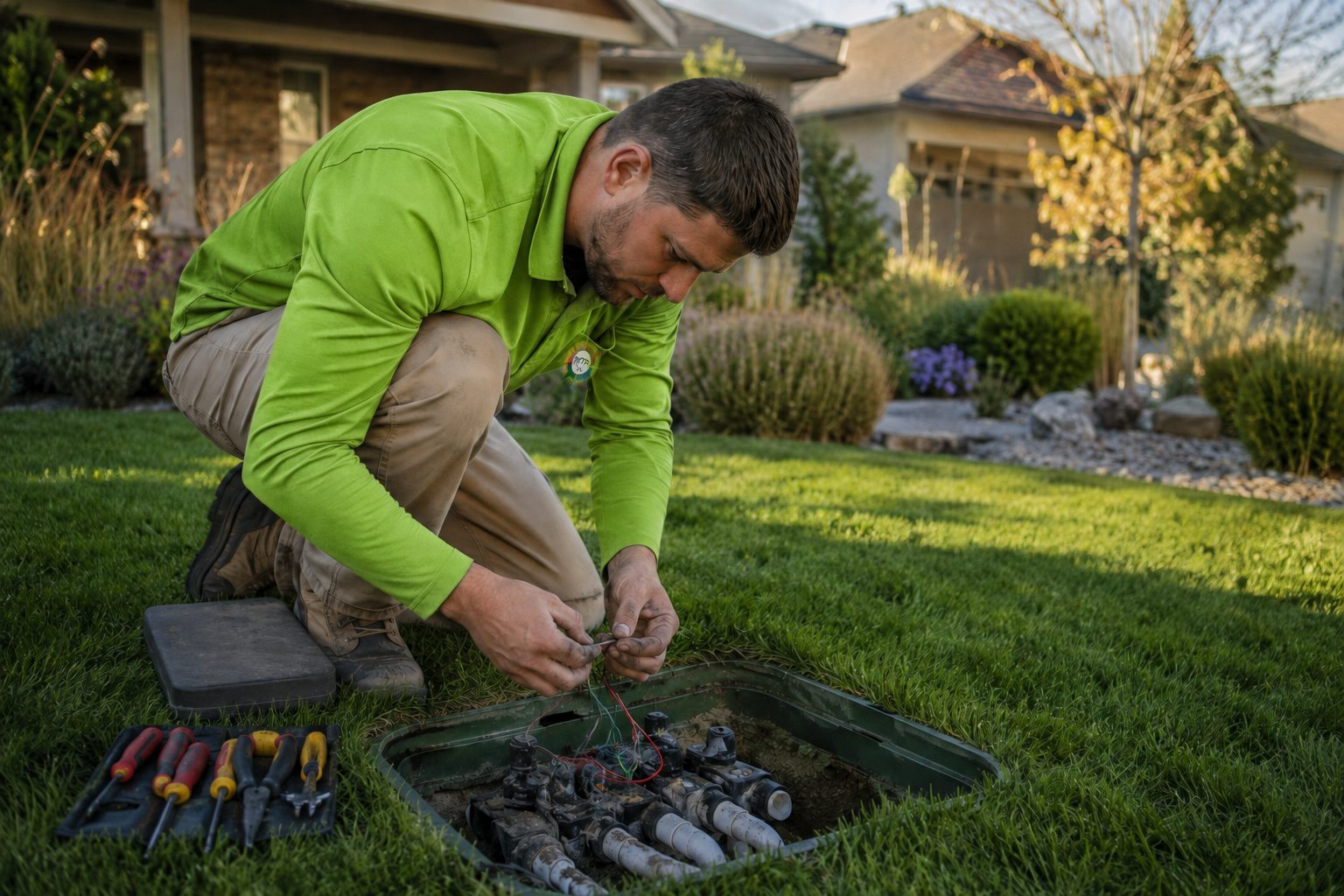
Valve bodies, solenoids and manifold fittings hold standing water. A cracked valve body usually means excavating the box and rebuilding the manifold, not a simple swap.
Lateral lines and heads
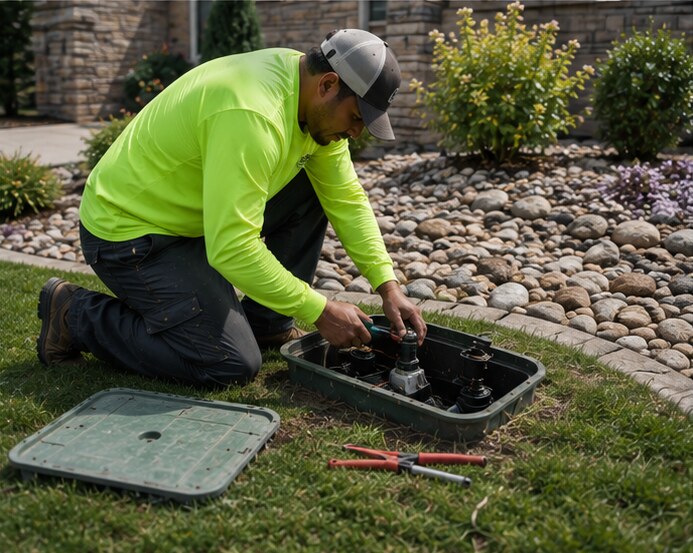
Poly and PVC laterals split along their length. Heads crack at the riser and the seal. These failures are often invisible until spring startup floods a section of lawn.
Spring repairs cost more than winterization. Every year.
We see the same thing every April — systems that were never blown out, now needing a backflow replacement, a manifold rebuild or a lateral dug up and re-run. The blow-out is the cheapest maintenance item on an irrigation system, and it is the one that protects everything else.
Timing
When to schedule it on the Front Range
Denver Water ends lawn watering after September 30 — and other Metro utilities set their own cutoff dates, so check the rule for your specific provider. Once watering season closes, there is no reason to leave water sitting in the system.
The hard deadline is your first hard freeze, and on the Front Range that can arrive any time from late September onward. Elevation matters — properties along the foothills and toward Castle Rock and Monument typically freeze earlier than lower ground in the metro. We route by area, so the earlier you are on the schedule, the more control you have over your date.
If a hard freeze is already forecast and your system has not been done, call rather than wait for a booking confirmation — 303-781-1991.
Our Process
What a proper blow-out actually includes
A blow-out is not one pass with a compressor. Done correctly it is a sequence, and skipping steps is what leaves water in the line.
Shut down and isolate the supply
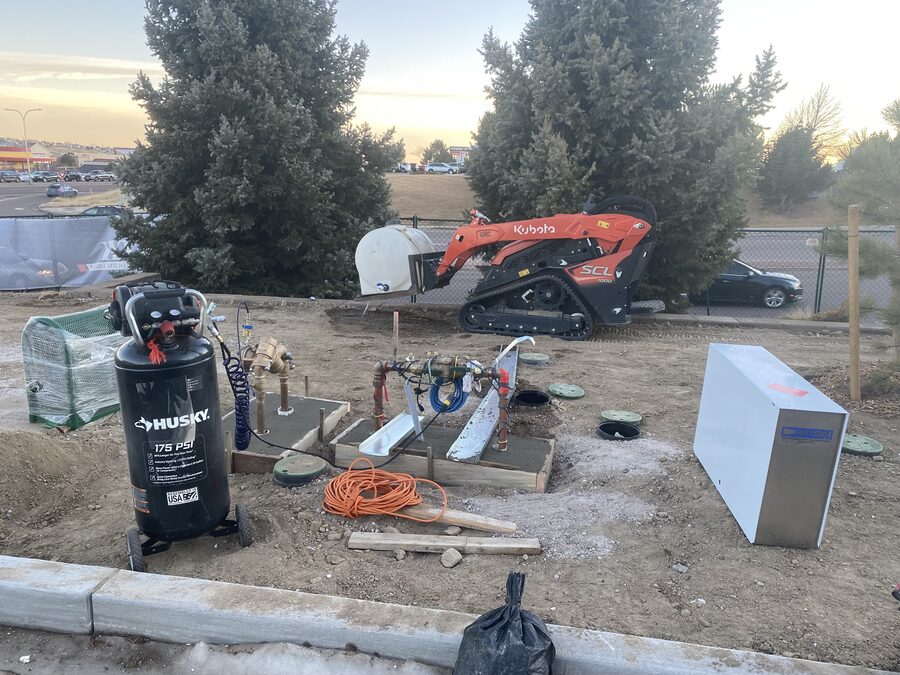
Water is shut off at the irrigation supply and the system is isolated, so the compressor is working against the irrigation lines alone rather than the building's water supply.
Connect at the correct point
Air is introduced downstream of the backflow assembly, not through it. Pushing shop air backward through a backflow device is a common way to damage the internals.
Clear one zone at a time
Each zone is opened individually and worked until the heads stop throwing mist and run dry. Zones are never run all at once — splitting the air between them is how water gets left behind in the laterals.
Cycle back through
Zones are revisited so that water that has migrated back to low points is cleared. A single pass per zone is where most incomplete blow-outs fail.
Drain and set the backflow
The backflow is drained and its test cocks and ball valves are left in the correct partially-open position so any residual water has somewhere to expand.
Shut the controller down for the season
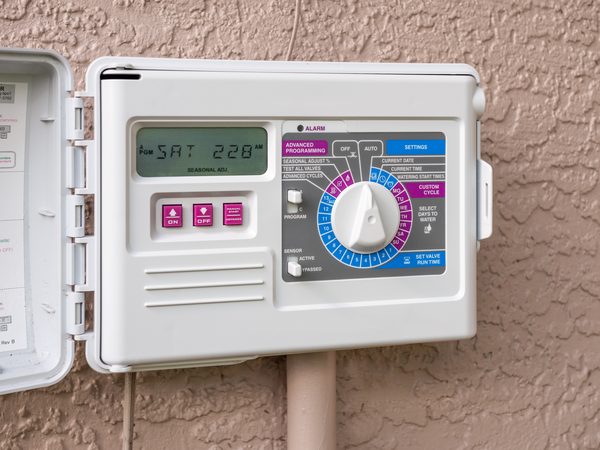
The controller is set to off or rain mode so it does not try to run a dry system through the winter, and we note anything we found that needs attention before spring.
Honest Comparison
Doing it yourself vs. having it done
Plenty of homeowners want to handle this themselves, and for some systems that is reasonable. Here is the part that decides it.
| | Typical DIY setup | What the job needs |
|---|
| Air volume |
A small pancake or portable compressor moves very little air. |
Clearing a zone is about the volume of air moved (CFM). A compressor that cannot move enough air leaves water sitting in the laterals no matter how long you run it. |
| Working the zones |
Zones opened together, or one quick pass each. |
One zone at a time, worked until it runs dry, then cycled back through. Splitting air between zones is how water gets left in the laterals. |
| Shop vacuums |
Sometimes suggested online. |
A shop vacuum cannot generate the airflow to clear a buried lateral. It does not do this job. |
| Backflow handling |
Air often pushed through the backflow device. |
Air introduced downstream, backflow drained and set correctly afterward. |
| What you find out |
Nothing until spring. |
A technician who is already at every zone notices leaking valves, broken heads and zones that are not reaching, while there is still time to plan the repair. |
Fall 2026 Savings
Book it on its own, or bundle it and save more
The blow-out stands alone, but it is already part of the fall visit — so bundling it with the work that has to happen anyway is where the savings are.
$20OFF
Sprinkler Blow-Out Coupon
Twenty dollars off your compressed-air winterization. Mention this page when you book.
The Triple Play
You save $25
Aeration · Winter Fertilizer · Blow-Out
Most Popular
The Fab Four
You save $50
Aeration · Winter Fertilizer · Revive · Blow-Out
$20 coupon terms: valid on one standard residential sprinkler blow-out ordered on its own. Not valid with package pricing or other offers. Expires September 30, 2026.
Biggest savings when booking by September 30th. Call or email for pricing and to schedule. Commercial and HOA properties are quoted by scope.
Get on the blow-out schedule
A real person reviews every request and responds within one business day. Residential and commercial, Greeley to Pueblo.